EP 564 EP 564 Validate Digital Products Before You Build | AI Entrepreneur Plan

Stop Building Digital Products Nobody Wants: The 48-Hour Weekend Validation Plan (Go / Fix / Park) Digital products need real demand—not just AI speed. Tracy shares a practical weekend validation plan for the ai entrepreneur: set go/fix/park thresholds, identify a specific buyer, and gather evidence through customer pain, existing spending, and real commitments like waitlists or payment. Learn how to test an idea before spending your limited family time building it, and use AI to support customer discovery rather than mistake fast creation for a business. https://DarkHorseEntrepreneur.com

 Apple Podcasts

 Spotify

 Podcast Addict

 iHeartRadio

 Castro

 Deezer

 Audible

 RSS Feed

 YouTube
Stop Building Digital Products Nobody Wants: The 48-Hour Weekend Validation Plan (Go / Fix / Park)
Digital products need real demand—not just AI speed. Tracy shares a practical weekend validation plan for the ai entrepreneur: set go/fix/park thresholds, identify a specific buyer, and gather evidence through customer pain, existing spending, and real commitments like waitlists or payment. Learn how to test an idea before spending your limited family time building it, and use AI to support customer discovery rather than mistake fast creation for a business.
https://DarkHorseEntrepreneur.com/s6e564
Sponsor - https://YourSuccessDNA.com
Click here >>Get Your Weekend AI Digital Product Validation Worksheet<<
Tracy explains how to validate a digital product idea before building, because AI can speed creation but cannot create demand. It defines evidence that counts—existing spend, buyers describing specific pain in their own words, and real commitment (emails, calls, waitlists, especially payment)—and dismisses opinions as “level zero.” The host lays out a six-step weekend plan: set go/fix/park thresholds on Friday, define a specific buyer persona, gather level-one and level-two proof on Saturday (marketplaces, reviews, forums, comments), then write a one-page offer, create a quick mockup, and ask real buyers for commitment on Sunday via conversations, pre-sale, or a specific waitlist. It emphasizes honesty for pre-sales, protecting reputation, scoring results against the sticky-note numbers, and treating “park” as a win that saves weeks.
Free Episode 564 Worksheet
The Weekend AI Digital Product Validation Worksheet
Friday night to Sunday evening, step by step, ending with a clear go, fix, or kill decision.
Open the free worksheet
00:00 The Build Fast Trap
01:52 Evidence That Counts
03:29 Set Go Fix Park Numbers
04:59 Choose A Real Buyer
06:13 Find Spend And Pain Proof
08:24 Write A One Page Offer
10:15 Mockup Before You Build
11:34 Get Real Commitments
13:36 Score And Decide Next
15:13 Cautions And AI Limits
16:18 Free Worksheet And Newsletter
17:12 Whisker Wisdom Exercise
18:02 Recap
Digital product validation, digital product, ChatGPT digital products, ChatGPT, Product market fit, Validate product idea, Side hustle, digital products, ai side hustle, micro business, ai automation business, online side hustles, business motivation, work from home, business mindset, entrepreneur motivation, entrepreneurship, ai content creation, side hustle ideas, entrepreneur mindset, business tips, how to make money online, make money from home, ai automation agency, AI, AI Tools, ai entrepreneur, make money online, side hustle ideas, make money from home, online side hustles, AI start up ideas, entrepreneur, ai business, how to validate a digital product idea, digital product ideas with AI, validate product idea before building, AI digital products, presell a digital product, side hustle for full-time workers, weekend side hustle plan, product validation, sell digital products, AI side hustles, digital products for beginners
https://DarkHorseEntrepreneur.com
Hosted by Simplecast, an AdsWizz company. See pcm.adswizz.com for information about our collection and use of personal data for advertising.
[00:00:00] Tracy Brinkmann: It sounds harmless, it sounds like action, and it quietly eats six weekends, a couple [00:00:05] hundred dollars in tools, and a big chunk of your self-belief. Because when launch day [00:00:10] comes, the silence is deafening. May- may all you hear is crickets. ChatGPT [00:00:15] made building a digital product ridiculously fast, an e-book, a template pack, a prompt [00:00:20] library, a mini course.
You can have a draft by Sunday night. And if you're thinking this could be your path to [00:00:25] massive income, you're not wrong. But there's a step almost everyone skips, because [00:00:30] ChatGPT did not make strangers want what you created. Speed of building is [00:00:35] not proof of demand. So today, we're gonna flip the order.
Before you build anything, your [00:00:40] idea has to earn its place. And by the end of this episode, you will have a weekend plan, [00:00:45] Saturday and Sunday, that tells you, "Go fix or kill your project before you [00:00:50] spend a single weekend building the wrong damn thing." And I'm gonna give you step four, [00:00:55] which is the one almost everyone skips.
This is the one that turns, "People said it was a great idea," [00:01:00] into actual evidence.
Dark Horse Entrepreneur [00:01:05] Podcast
What is up? What is up? What the hell is up, my fellow dark horse entrepreneurs? Let's get stuck right in [00:01:10] today. The three things you're gonna learn if you stick around with me today is, one, the three kinds of evidence that [00:01:15] actually count and the one kind of evidence that feels great, but means almost nothing.
You'll [00:01:20] get that in just a minute here. Two, the six-step weekend validation plan that you can [00:01:25] run even while you're holding down a full-time job. Saturday is for finding the buyer and proof. Sunday [00:01:30] is for writing the offer and asking for a real commitment. And three, this is gonna be your go, [00:01:35] fix, or kill numbers.
You're gonna decide the pass mark before you start the test, not after, [00:01:40] so you can't talk yourself into saying yes to yourself. I'll give you starting thresholds that [00:01:45] you can use as is. And at the end, a little whiskered wisdom for you, one small move that you can [00:01:50] make tonight that takes about 10 minutes.
Okay, let's go. Let's start with the trap. All right? [00:01:55] You tell a friend your product idea. They say, "I would totally buy that." We, we've all done that, right? You, you [00:02:00] feel amazing, and that sentence really is worth nothing. Not because your friend [00:02:05] is lying, because saying yes costs nothing. Compliments are free.
[00:02:10] Predictions about what we will buy someday are famously unreliable. People are [00:02:15] kind, and the future is cheap. So here is a rule for this whole episode. [00:02:20] Evidence costs the buyers something: time, attention, reputation, [00:02:25] or money. The more it costs them, the more it counts. If it costs them nothing, it's not [00:02:30] evidence.
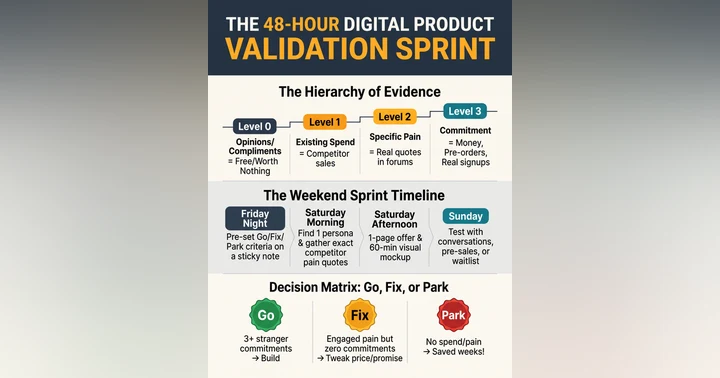
Let me give you three levels here. Level one, existing spend. People are already paying [00:02:35] for something that solves the problem you're considering solving. Books, templates, courses, [00:02:40] coaches, software. That's good news, not bad news. Competition means the market already [00:02:45] exists out there. Level two, specific pain in their own words.
Real buyers [00:02:50] describing the problem. Unprompted, in forms, in reviews, in comments, or in a [00:02:55] conversation with you directly. Not, "That sounds cool." Things like, "I've wasted three Sundays [00:03:00] trying to set that up." That is real evidence. Three, level three, commitment. Someone [00:03:05] gives you an email for this specific thing, or they book a call, or they join a waitlist with [00:03:10] a real reason, or best of all, they pay or they pre-order.
Yeah? [00:03:15] Opinions don't fit into level one, two, or three. Opinions are level zero. They [00:03:20] don't even go up on the scoreboard. Keep those three levels in your head because the weekend [00:03:25] plan is just a fast way to climb those level faster. Okay? Before Saturday, [00:03:30] I want you to set your go, fix, or kill numbers. All right?
So what you're gonna do [00:03:35] is on Friday night, you're gonna take about 10 minutes, and you're gonna write down what pass looks [00:03:40] like before you even start your product. Because if you decide after the test, [00:03:45] your brain is gonna start grading on a curve every single time. Trust me on this. And here are [00:03:50] the thresholds, I promise you.
And they're not magic numbers. Don't get me wrong. They are a reasonable bar for a [00:03:55] small, low-priced digital product, and you should adjust them based on your audience size and [00:04:00] the price you go with. Okay? Let's talk about the go level. At least three people that you [00:04:05] don't personally know take a real commitment step, ideally a payment or a pre-order, [00:04:10] or one paid pre-order plus several strong conversations, okay?
[00:04:15] That's your go signal. Your fix signal is you have people clearly that have a [00:04:20] pain. They engage, they reply, but nobody commits. That usually means the offer, [00:04:25] the price, or the promise is a little off, but it's not the problem. The problem that you're [00:04:30] solving is actually out there. And kill or park, let's call it either one of those two because some [00:04:35] of the platforms won't let me say that word, I'm gonna kill this project or I'm gonna park the project.
You [00:04:40] can't seem to find real people describing that pain that your product would solve, and no one [00:04:45] is paying for anything nearby it. That's not a failure. That's a weekend that you just [00:04:50] saved. So after you figure out what those numbers are, you wanna write those numbers on a sticky note. [00:04:55] Seriously, I want you to do that because that note is gonna be your referee.
Most [00:05:00] digital products fail before they're ever made because they're aimed at anyone who wants [00:05:05] to make money or busy people or beginners. That's not a buyer. That's a [00:05:10] crowd, okay? Your buyer persona, some people call it your customer avatar, [00:05:15] it's gonna have three parts: who they are, what situation they're in, and what is that [00:05:20] situation costing them?
Let me give you a weak version. A weak version of your buyer persona is a [00:05:25] productivity template for busy people. No, that's not what you want. Strong version, solo [00:05:30] bookkeepers who lose two hours every month end chasing client receipts. You see the difference? [00:05:35] You can almost picture that person in your mind's eye.
You can easily find them, and you know [00:05:40] what they would pay to fix. You can use ChatGPT or Claude here as a sparring partner, but don't use it as [00:05:45] an oracle, right? Ask it something like, "List 20 specific situations where a [00:05:50] solo bookkeeper wastes time every single month. For each, who feels the pain most, [00:05:55] and what does it cost them?"
Then you can choose. ChatGPT can generate different options, [00:06:00] but only real people can confirm that those options are their pain points. Those are [00:06:05] the conversations you have. Pick one, not three. One buyer, one problem, and spend one [00:06:10] weekend. That's it. You start picking more, you're gonna suck up a bunch of time you don't have.
Now, you need to go [00:06:15] find level one and level two evidence. Give yourself about two hours for this. H- here's what you can [00:06:20] do. For existing spend, look where products like this already, already are selling. [00:06:25] Gumroad, Etsy, Teachable, Stan Store, Amazon Books in that category. You're looking [00:06:30] for products that solve a nearby problem and show you signs of real buyers, and [00:06:35] these signs are reviews, ratings, sales counts, wherever those sales counts are shown.
If [00:06:40] you find nothing anywhere, I want you to be careful. Sometimes there is an open [00:06:45] lane, but more often than not, it's a lane that no one wants to be in, and that's where people [00:06:50] end up wasting time and money. Okay? And next, you also wanna look for their pain in [00:06:55] their own words, right? You wanna go where the buyer is gonna be complaining.
Reddit, Facebook [00:07:00] groups, niche forums, YouTube comments under tutorials on the topic [00:07:05] that you're gonna be writing about. And here's a favorite of mine, those one and two-star [00:07:10] reviews from competitor products. One-star reviews are gonna tell you what people hate. [00:07:15] Three-star reviews are gonna tell you what they wanted and didn't get, and that's your product gap, [00:07:20] and it's written by the customer, not you.
Oh, not even ChatGPT, for that matter. Copy the [00:07:25] exact phrases that you find into a document. Don't paraphrase because you [00:07:30] want their own words. Just literally copy and paste it in there. Okay? And here's a useful move here. [00:07:35] Paste in the quotes that you collect and then ask ChatGPT to group them by theme and [00:07:40] rank which pains appear most.
'Cause you could spend, you know, like I said, two [00:07:45] hours going through and doing all this research and then have to go through and sort them. ChatGPT is really good for this. It's a [00:07:50] real time saver. But just don't let it invent quotes. You, you can actually tell it, "Only use these quotes in [00:07:55] here." Only feed it what real people have actually said.
By lunchtime now, you should be able to [00:08:00] answer two questions. Is anyone out there already paying to solve something close [00:08:05] to the problem my product would solve? And can I show five or more real people [00:08:10] describing this pain that my product would resolve in their own words? If both [00:08:15] answers are no, that's important information to have.
Go back to step one, pick a different [00:08:20] problem or pick a different buyer, and then restart your two hours. Okay? Here's a mindset [00:08:25] shift I wanna drop here for you. You don't need the product to test the product. Yeah, so many [00:08:30] people get stuck on this. You do, however, need an offer, and that offer is one page. H- heck, it [00:08:35] could even be one paragraph, and that one page or that one paragraph needs to answer four [00:08:40] questions.
Who is this for? That's your, your buyer persona we talked about. What result does it help them [00:08:45] get? This is where you're gonna use their words from the quote document you put together. What [00:08:50] exactly will they receive? And you're gonna wanna be very concrete here. Example, a 12-page [00:08:55] checklist and three email templates beats, "You will get a complete system."
Y- you feel me? Get... Tell [00:09:00] them w- exactly what they're gonna receive. What does it cost? Pick a real price. You, you may [00:09:05] find that it's over or under, but pick a real price. For a first small digital product, most [00:09:10] creators, they start low, but do me a favor, avoid free. Free tests interest. [00:09:15] Price is what's gonna test real demand.
Here's an example from our bookkeeper we're, we're [00:09:20] building off of. Let's say your paragraph is gonna say something like this: "The month-end receipt rescue kit [00:09:25] for solo bookkeepers tired of chasing client receipts. You're gonna get three copy and paste [00:09:30] client email sequences, a receipt request checklist, and a one-page policy you can send to [00:09:35] new clients, all built to help you cut your month-end chase time, and it's only $19."[00:09:40]
See? Simple. You don't have to overcomplicate this. Notice it doesn't promise any guaranteed [00:09:45] outcome or any specific number of hours saved. It promises a clear set of tools aimed [00:09:50] at a very clear pain. This is what getting to product market fit actually looks [00:09:55] like at the micro level, not the macro level. A specific buyer, a specific [00:10:00] problem, and a specific solution.
Bam. There it is. ChatGPT can help you write [00:10:05] 10 versions of this in a few minutes. Ask it to use the exact customer phrases that you collected, then [00:10:10] pick the one that sounds most like your buyer, not the one that sounds most like a [00:10:15] marketer. Okay? This is the fourth step that I teased up at the beginning of this episode.
This is the one that [00:10:20] most people skip, and hopefully you will not now that you hear it. Instead of building the whole [00:10:25] product, build something that shows the product, a cover image, a sample page, a [00:10:30] screenshot of the first template, a table of contents. 30 to 90 minutes tops is what [00:10:35] any of this is gonna take you.
Why does this matter, Tracy? Well, let me tell you. Because people respond to what they [00:10:40] see. Would you buy a receipt kit? Gets a polite shrug. A clean image of a [00:10:45] kit with the first email template visible gets a realer reaction. Either, "Where do [00:10:50] I get this?" Or it gets silence. Both of those reactions are useful.
Both of them tell you [00:10:55] something. And if you put that mockup on a simple landing page, your one offer paragraph, [00:11:00] the mockup, and an action button, that button is where the real evidence is gonna begin to show [00:11:05] up. Here are two honesty rules here, and these, my friends, are non-negotiable. [00:11:10] First, if someone can pay before the product exists, say so plainly.
Put it in there. [00:11:15] This is a pre-sale. The kit ships on, and give them a specific date. Name that [00:11:20] date. Second, offer a full refund if you decide not to build, and please [00:11:25] mean it. You're testing demand. You're not trying to trick people. Your reputation is the one [00:11:30] asset you will never, ever be able to build, not even with AI.
Okay? Now, you wanna [00:11:35] take that landing page to real people. I don't want you to take it to your mom. Don't take it to your [00:11:40] best friend, unless, of course, your best friend runs a, a bookkeeping organization. But you wanna take it [00:11:45] to people who match your buyer persona, and here's three ways you can do that.
Pick whatever fits your [00:11:50] situation out of these three. Way number one: have conversations. Message 10 to 20 people [00:11:55] who fit your buyer description. Many of them will be in the same communities where you found the pain [00:12:00] when you were doing your research. Be respectful of each group's rules. Most of these platforms or [00:12:05] groups will not allow promotion, so lead with a question, not a pitch.
Something like, "I'm [00:12:10] putting together a small kit for solo bookkeepers on month-end receipt chasing. Would you be open to [00:12:15] a quick chat on how you handle this now?" In that conversation that you have, ask [00:12:20] about the past. Don't ask about the future. Tell me about the last time this happened to you. What did you try?[00:12:25]
What did it cost you? Because past behavior is evidence. Future promises, they're just [00:12:30] compliments. Okay? At the end of the conversation, show them the mock-up and the price, and then [00:12:35] ask them directly, "If this existed this week, would you want it for..." And then give them the price. [00:12:40] Then, and this is the important part, if they say yes, give them a way to act on it [00:12:45] right then and there.
Okay? Way number two is the pre-sale. I have done this one a couple of times, and it's been [00:12:50] very successful. Your landing page includes a real payment option, and the pre-sale date, and [00:12:55] the refund promise clearly stated. Payment is the strongest form of evidence you [00:13:00] will ever get, okay? And see how many people sign up.
The last time I did this was for a, a [00:13:05] podcasting course I hadn't even created yet, and within two hours, I had 18 people signed up, [00:13:10] okay? Here's way number three, the specific wait list. If a pre-sale, let's say that's not wa- [00:13:15] ready for you right now, use an email sign-up, but make it specific. Not, "Join my [00:13:20] newsletter."
Instead, "Get the receipt rescue kit at launch price when it's ready." It's weaker than [00:13:25] money committed, but it's stronger than, "Ooh, that sounds cool." Okay? Share the landing page wherever your [00:13:30] buyer already is and the promotion is allowed. Plus, put them in your profiles and any small [00:13:35] audience that you may already have.
Okay? Now, go ahead and pull out that sticky note you created on [00:13:40] Friday and count what counts. Payments, specific sign-ups, booked calls, [00:13:45] strong pain stories from strangers. Then make the call. Go fix or [00:13:50] park. If you get a go signal, you hit the bar. You got the right numbers there. Now you [00:13:55] build, and you build fast because you already have buyers waiting, and you know exactly what they ask [00:14:00] for.
Your quote dart is your outline. And if this becomes something people buy without you doing any [00:14:05] initial work each time, that's what passive income actually looks like. Earned, [00:14:10] not assumed Fix signal. They have a pain, they engaged, but nobody [00:14:15] committed. Change one thing and re-run a smaller test next weekend.
Usually, I [00:14:20] find it's the promise or the price, and sometimes it's the buyer, too. Change one of those. [00:14:25] Change only one or you won't know what works, okay? Until you find you [00:14:30] get a go signal. In kill or park, there's no pain, there's no spend, there's no [00:14:35] commitment. Close that doc. Write one sentence about what you learned, 'cause you will learn.
You [00:14:40] have just collected a bunch of data. Then go pick a new problem. You've just saved yourself [00:14:45] weeks creating something that got you crickets. And at the same time, you just got better [00:14:50] at this very thing you're trying to do. And here's the part that no one says out loud. A kill or [00:14:55] park is actually a win.
Most people find out their idea doesn't work [00:15:00] after they've built it, priced it, launched it, and posted about it. That's when they found [00:15:05] out. You found out within 48 hours and it cost you a sticky note. That, [00:15:10] my friends, is a real quality reality check. I wanna give you three cautions here. [00:15:15] One, small numbers are noisy.
Three buyers this weekend doesn't guarantee [00:15:20] 300 next month. It usually means you've cleared the first bar, but you should keep validating as [00:15:25] you grow. Big creator results that you hear out there are not your forecast. You will [00:15:30] see videos about people making big money from their digital products. Treat those [00:15:35] numbers as their report results, not a prediction of what you could possibly gain.[00:15:40]
Your evidence is the only evidence that matters for your idea. And the third [00:15:45] caution I wanna leave you with is ChatGPT drafts, but you decide. [00:15:50] ChatGPT and all the other tools are out there, they're great at brainstorming, grouping quotes, and drafting orders. They, [00:15:55] my friends, are not customers. Never let them stand in for a real person's pain, [00:16:00] and never publish AI-generated reviews or testimonials.
I've seen that done. It's [00:16:05] shady. Again, it comes back to your reputation. Eric Ries, who wrote The Lean Startup, put it simply: [00:16:10] get out of the building and talk to real people, real customers. No large [00:16:15] language model is ever gonna replace that, okay? Now, everything we just walked through, [00:16:20] the pass mark, the buyer persona, the quote doc, the offer, the scoreboard, it's a lot to [00:16:25] hold into your head on a Saturday morning or during a podcast.
So I, I put this all into [00:16:30] a one-page document for you. It's called the Weekend Validation Worksheet. Step by step, Friday [00:16:35] night, all the way through to Sunday evening, with a spot for every piece of evidence that you collect, and a [00:16:40] quick go, fix, or park read at the end. It's free, and it's gonna be in the link [00:16:45] down in the show notes.
But here's the thing, validating one idea is a skill that you build. If you want [00:16:50] help building it every week with practical evidence-first moves for building a side hustle [00:16:55] around your full-time job, around your family life, go ahead and join the AI Escape Plan newsletter. That's gonna be [00:17:00] over at darkhorseinsider.com.
That's darkhorseinsider.com. And again, [00:17:05] the link to the full Weekend Validation Workshop will be down in the show notes. Go check that out [00:17:10] for yourself. Free, no email required. Now, okay, now we come to my favorite part of the episode. [00:17:15] This is your Whisker wisdom for this week. You like the new chapeau? I [00:17:20] think it fits the whole Whisker wisdom vibe.
Here's your one step tonight, and it takes about 10 [00:17:25] minutes. Open up a note on your phone and write one line: "I believe buyer [00:17:30] will pay price for result." Fill in the blanks for your own idea. [00:17:35] Now, under that, I want you to write, "The evidence that would prove me wrong is," and [00:17:40] then fill in that blank. Finish that sentence.
That second line is the real [00:17:45] secret that most people are gonna miss. Most of us look for evidence that we are right, that [00:17:50] what we're doing is amazing. When you name in advance what would prove you wrong- [00:17:55] You turn your idea from hope into a real test, and tests are [00:18:00] something that you can run this weekend.
Now, let's bring this all home, shall we? Evidence [00:18:05] costs the buyer something. Set your go, fix, kill, or park numbers first. Do that before you [00:18:10] even start anything. Saturday, go find one buyer and their pain in their own [00:18:15] words. Then write the offer, make a mock-up, and then on Sunday, ask for a real commitment on [00:18:20] your landing page.
Then score it, and score it honestly. Look, you don't need more [00:18:25] weekends. You need the right weekend, one where the market tells you what to build before you [00:18:30] ever spend any time building it. Whatever the result, go, fix, or park, you walk [00:18:35] away Sunday night knowing more than most people who just started building and prayed [00:18:40] and hoped.
With that, I'm gonna leave you as I always do. Think successfully and take action.