EP 565 Make Money Online With a Micro App | Validate Before Building
Build an AI App That Actually Sells: The 5-Step Micro App Validation Test Make money with an AI app by validating demand before you build. In this episode, Tracy explains why fast “vibe coding” doesn’t guarantee sales—and why competitors prove a market exists, not that customers will choose your app. Hear a five-step micro-app validation test to help AI entrepreneurs spot a real customer problem, identify a reason to switch, and avoid building an unwanted product. A practical strategy for parents pursuing online entrepreneurship and a flexible side hustle.

 Apple Podcasts

 Spotify

 Podcast Addict

 iHeartRadio

 Castro

 Deezer

 Audible

 RSS Feed

 YouTube
Build an AI App That Actually Sells: The 5-Step Micro App Validation Test
Make money with an AI app by validating demand before you build. In this episode, Tracy explains why fast “vibe coding” doesn’t guarantee sales—and why competitors prove a market exists, not that customers will choose your app. Hear a five-step micro-app validation test to help AI entrepreneurs spot a real customer problem, identify a reason to switch, and avoid building an unwanted product. A practical strategy for parents pursuing online entrepreneurship and a flexible side hustle.
https://DarkHorseEntrepreneur.com/s6e565
Sponsor - https://YourSuccessDNA.com
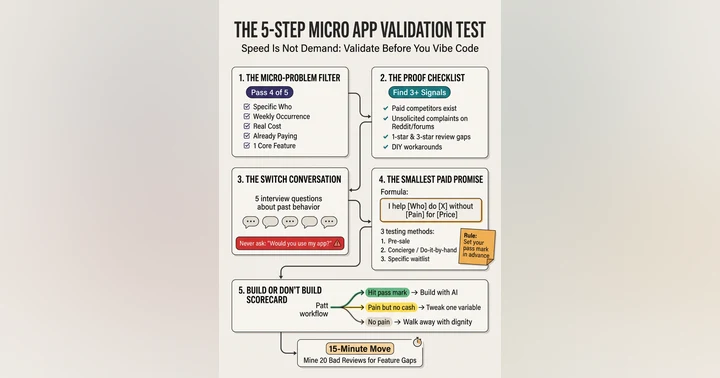
Tracy argues that AI “vibe coding” makes it easy to build an app quickly but doesn’t create demand, so most unwanted apps won’t sell. It weighs the YouTube debate between copying proven apps and validating ideas, concluding that existing competitors prove a market exists but not that customers will buy from you, which requires a clear reason to switch. The host presents a five-step test to run before building: a micro problem filter (five questions to define a small, sharp problem for a specific user), a proof checklist (evidence like paid competitors, complaints, bad reviews, alternative searches, and homemade workarounds), real “switch” conversations with 5–10 target users using past-focused questions, a “smallest paid promise” tested via presale, manual delivery, or a specific waitlist, and build/don’t-build signals based on a pre-set commitment threshold. It ends with cautions about unverified income claims, avoiding gaming communities, and using AI as a tool—not a customer—and a 15-minute action to read competitor 1- and 3-star reviews for switch insights.
Free Episode 565 Freebie
The Micro-App Validation Checklist
Run the 5-step test before you vibe code a single screen. Find out: build it or don't.
Get the Free Checklist
00:00 Vibe Coding Reality Check
01:14 Validation Versus Copycats
04:08 Speed Is Not Demand
05:37 Step One Micro Problem Filter
08:26 Step Two Proof Checklist
10:50 Step Three Switch Conversations
13:53 Step Four Get Paid First
17:01 Step Five Build Or Walk Away
18:51 Straight Talk Cautions
20:13 Free Validation Checklist - https://DarkHorseEntrepreneur.com/s6e565
21:25 Whisker Wisdom
22:12 Final Recap
vibe coding make money, how to validate an app idea, micro saas ideas, build an app with ai, presell an app before building, vibe coding, validate app idea, micro saas, build an app with ai, chatGPT, cursor, lovable, bolt.new, make money online with ai, ai content creation, digital marketing, make money online, marketing, marketing strategies, marketing tips, online business, online entrepreneurship, online opportunities, passive income, work from home, ai tool entrepreneur, make money, ai entrepreneur, ai side gig, online entrepreneurship, ai side hustle, micro business, ai automation business, online side hustles, business motivation, work from home, business mindset, entrepreneur motivation, entrepreneurship, ai content creation, side hustle ideas, entrepreneur mindset, business tips, how to make money online, make money from home, ai automation agency, AI, AI Tools, ai entrepreneur, make money online, side hustle ideas, make money from home, online side hustles, AI start up ideas, entrepreneur, ai business
https://DarkHorseEntrepreneur.com
Hosted by Simplecast, an AdsWizz company. See pcm.adswizz.com for information about our collection and use of personal data for advertising.
00:00:00] Tracy Brinkmann: You can build an app this weekend. Seriously. You can type what you want into ChatGPT or [00:00:05] Cursor or Claude, and it spits out code. You click a button and boom, you've got [00:00:10] a real working app with your name on it. This is what they call vibe coding, and it's absolutely [00:00:15] real, and on Monday, nobody buys it. Not one person.
That's the part that no one puts [00:00:20] into their thumbnail. AI made building fast. It did not make [00:00:25] unwanted apps profitable for the maker. It just made it a whole lot quicker to build something [00:00:30] that really nobody asked for. And if you want to actually make money online with AI, [00:00:35] you've got to do one thing first.
So today I'm gonna hand you the five-step test [00:00:40] that you can run before you write a single prompt into ChatGPT or Lovable or [00:00:45] Bolt.new, what- whichever platform you choose. It costs you just a couple of evenings, but [00:00:50] not a couple of months, and at the end of it, you will know whether you should build it or [00:00:55] not.
And stick around for step number four because there's a way to get paid for your app [00:01:00] before your app ever even exists. Totally honest, totally legit, and [00:01:05] almost nobody does this.
Dark Horse Entrepreneur [00:01:10] Podcast
What is up? What is up? What the hell is up, my dark horse friends and family? All right, let's get stuck [00:01:15] into the three things you're gonna learn if you stick around with me today. First, I'm gonna settle an argument that's [00:01:20] all over YouTube right now. One camp says validate everything. The other camp says [00:01:25] forget validation, just copy an app that's already making money.
I'm gonna tell you who I think is [00:01:30] right, and you'll get that in the next minute or so. Second, I'm gonna give you the five-step [00:01:35] app test: the problem filter, the proof checklist, the switch conversation, [00:01:40] the smallest paid promise, and the build or don't build signals, right? That's the call [00:01:45] you're gonna have to make.
And then third, the exact questions you should ask a real human [00:01:50] being so that you get the truth instead of a, just a polite, "Oh, well that sounds neat," right? And then finally, [00:01:55] I'm gonna give you the usual whiskered wisdom, that one tiny thing that you can do tonight that will take you 15 minutes [00:02:00] tops. So let's get stuck right in, shall we?
Okay. So what led to this particular episode [00:02:05] is I went down a rabbit hole. I, I pulled up a stack of popular how I make money building [00:02:10] apps videos out there on YouTube, and a couple of them say the same thing, almost word for [00:02:15] word. One creator, Your Average Tech Bro, he says flat out, "You don't need to come up with a new [00:02:20] idea, just copy what already exists."
And his logic is if other apps are already [00:02:25] making money, someone else did the hard work of proving the market. Then there's another creator, uh, [00:02:30] Dennis Babich. He basically said the same thing, only louder with m- far more colorful language. [00:02:35] And you know what? They're half right. Yeah, half right. That half matters.
If people [00:02:40] are already paying for the apps that solve a problem, that's real evidence. Money changing hands is [00:02:45] about the best proof there is that a problem hurts a customer enough for them to [00:02:50] pay for it. I'd take that over my cousin saying, "Cool idea," any day of the week. [00:02:55] But here's the half that they're skipping.
Proving a market exists is not the same as [00:03:00] proving anybody will buy from you. Ah-ha-ha. Yeah. Think about that for a second, and then [00:03:05] think about it like this. There are, let's say, a dozen pizza places in most towns. Pizza is a [00:03:10] proven market. No one's arguing that. But if you open a pizza place number 13, you [00:03:15] have the same menu, you have the same price, maybe you have a worse location, and you have no sign [00:03:20] out front, you're gonna be eating a lot of leftovers at the end of every shift of your new [00:03:25] pizza establishment.
The copycat crowd is right that you don't need to be original. [00:03:30] Originality can be overrated. What you need is a reason to switch And here's [00:03:35] what I mean. One specific person, one specific annoyance with what it is that they're using right now, [00:03:40] and one specific thing that you and your app do better. And to be fair to [00:03:45] the creators I, I listen to out there, even Dennis Babic tells people to throw up a simple landing page [00:03:50] and see if anyone will pay before building the full thing.
So even the just copy it [00:03:55] crowd is testing demand. They said it themselves. They just didn't put it in the title. So here's [00:04:00] the answer. Existing apps can prove the market, but they don't prove your app [00:04:05] That's what the next five steps I'm gonna give you are for. We're gonna talk about why speed [00:04:10] is not demand.
A- and real quick, before I give you the steps, I wanna show you how easy this trap is [00:04:15] to fall into, even for people who know what the hell it is that they're doing. There's a story from [00:04:20] Starter Story Build where an experienced iOS developer builds a mood tracker app [00:04:25] start to finish using AI tools, and did it in about 37 minutes.
That's impressive [00:04:30] if you ask me, genuinely. It's, uh, had some good design thinking, uh, and also used some smart [00:04:35] choices to keep in one specific feature. Now, right about near the end of the video, the [00:04:40] host asks a question. Paraphrasing here. "Okay, we built it, but how do we get people to pay [00:04:45] for this?" That is the question.
And it showed up after the building was [00:04:50] done. Now, mind you, I'm not knocking that creator. I'm not knocking that channel. The video is a build [00:04:55] tutorial, and it's a good build tutorial. But if you think about it, that's exactly the [00:05:00] order most of us go in when we get excited about it. We build first, we figure out the money [00:05:05] later.
And AI makes build first feel so cheap that we just stopped asking, [00:05:10] is this the right way? Here's the thing about cheap. Code got cheap. Your evenings, they didn't get [00:05:15] cheap. They never were cheap. If you've got a job and kids and maybe two hours after [00:05:20] bedtime or anywhere in your day, those hours are probably the most expensive thing that you own, [00:05:25] and you should guard them.
That's the whole case for the micro SaaS model, a [00:05:30] bootstrap solo founder product that earns monthly recurring revenue without you having to [00:05:35] trade every hour for every dollar that you earn. Step one, let's find the micro [00:05:40] problem filter, okay? Most beginner app ideas are way too big, and I'm gonna [00:05:45] create an app to help people stay organized or to get organized.
An app for a small [00:05:50] business. That's not, really not a problem. That's an entire weather system, right? That's a, an [00:05:55] entire geological system if you think about it. A micro app, however, solves one [00:06:00] small, sharp, annoying problem for one kind of person. So you run your idea through [00:06:05] five questions, and if you can't pass at least four of these questions, go ahead and toss that [00:06:10] idea back into the lake and let it get a little bit bigger, okay?
Or set it up on the shelf and let it grow some more. [00:06:15] One. Question number one, who exactly has it? The problem, that is. Not people. [00:06:20] A person with a job title or a situation. Maybe it's dog groomers who [00:06:25] book by text messaging, right? Or it could be youth cheer coaches juggling [00:06:30] 12 parents at a time, right? All the parents on the cheer team.
Question number two, how often does this [00:06:35] problem happen? Is it weekly? Is it better? I mean, if it's weekly or better, it's great. Is it [00:06:40] once a year? That's kind of tough to build a paid app around. You feel me? Okay. Question number three: [00:06:45] What does it cost them right now? And that cost could be in time, money, embarrassment, [00:06:50] missed sales, right?
Whatever it might be. If the honest answer is, "It's just a little annoying," [00:06:55] then it's a nice-to-have, and nice-to-haves really don't pay well, if at all. Question number [00:07:00] four: Are they already paying something to deal with it? Maybe they're paying for another app, a [00:07:05] spreadsheet template, a virtual assistant, or maybe their payment comes in the form of their Mon- their [00:07:10] Saturday mornings.
Remember, existing spend is good news. The market's already out there. [00:07:15] Last but not least, question number five: Can one feature fix the core of that [00:07:20] problem? If your fix needs 10 features, it's not a micro-app. You need to shrink it, okay? [00:07:25] Now, Esman Young, another app creator and someone well-known in the indie hackers bootstrap [00:07:30] founder world, gives a nice, simple formula for this, and it goes something like this: I want to build an [00:07:35] app that does X to solve Y problem for these users.
If you [00:07:40] can't fill out all three of those blanks, you're not ready to build yet. You're ready to go listen to [00:07:45] more people, mm-kay? Use AI as a, a sparring partner and a brainstorming partner here. You can [00:07:50] drop a prompt into ChatGPT and ask something like this: List 20 [00:07:55] small recurring annoying tasks that cheer coaches deal with every week.
And [00:08:00] what'll happen is, is ChatGPT will come back and start throwing spaghetti up on the wall and give you [00:08:05] all these recurring small annoying tasks and these problems that they deal with, and then you get to pick. [00:08:10] AI can guess at the problems, but let's be honest, only real people out there can [00:08:15] confirm them.
And yes, that's gonna mean either you're in that industry, in the case of the [00:08:20] example I gave you, cheer coaching, which my daughter was in cheer for, gosh, almost a over a decade, [00:08:25] so that's the one that popped into my head. Here, step two, let's create the proof checklist, 'cause [00:08:30] now that you have those questions, now you can go hunting for evidence.
Not opinions, [00:08:35] evidence. And the rule is simple: Evidence costs somebody something. And I said this in the last [00:08:40] episode as well. So here's your checklist, and if you can grab three or more from this [00:08:45] checklist, you are in good shape and ready to move forward. Number one is paid competitors [00:08:50] already exist. You can go look in the app stores and on sites like Product Hunt for apps [00:08:55] solving this problem, the problem that you came up with, or something really close to it, maybe just adjacent to it.[00:09:00]
You wanna go in there and you wanna check their reviews, and you wanna check their ratings. Lots of reviews mean [00:09:05] lots of users, okay? Number two, people complaining in their own words. [00:09:10] Go out there and search Reddit, search the Facebook groups, search the niche forums, and you're gonna be [00:09:15] looking for real people describing that exact problem that you came up with without anybody [00:09:20] asking them to, right?
They're going on there and they're going, "Oh my God, if someone could please solve this for me," [00:09:25] or, or whatever the terms they might use. Number three, bad reviews from the competition you [00:09:30] found earlier. This one is real gold. One-star reviews tell you what people [00:09:35] hate. Three-star reviews are gonna tell you what they liked, then it's also gonna tell you what they [00:09:40] wanted and didn't get.
And that gap right there, that's where your app should live. Number four, [00:09:45] people searching for alternatives. Maybe you type in the competitor's name plus the word [00:09:50] alternative, and you drop that into Google. If people are already actively looking to switch, someone's [00:09:55] unhappy, and unhappy customers are already open to a new option.
And next [00:10:00] one is homemade workarounds. Yeah, this one I haven't mentioned before. Somebody [00:10:05] built maybe a clunky spreadsheet or a template or a 14-step process, and they're sharing [00:10:10] it on Reddit, in Facebook, or on a forum. When people duct tape a solution together, [00:10:15] the pain is real, okay? Now what you wanna do here is you wanna copy every [00:10:20] exact quote that you stumble across into a doc.
Do not clean it up. Do not paraphrase [00:10:25] it. Do not put it in your own words. You want their words, because their words are gonna help you write [00:10:30] your sales page, okay? But here's a fair warning I wanna drop on you right here. If you find [00:10:35] zero competitors and zero complaints anywhere, I want you to be careful.
Every now and then, as [00:10:40] I, I mentioned in the last episode, that could mean that there's a lane wide open. But [00:10:45] most of the time it means it's really an empty road for a reason, and maybe you haven't [00:10:50] found that reason yet. Now, that then brings us to step three, which is the switch conversation. This is [00:10:55] the step that most creators are gonna chicken out, but not you, because you're here and you're listening.
[00:11:00] You have to talk to real humans. AI is great and is a great sparring partner and a [00:11:05] great brainstormer, but stick with me here, because this step is gonna separate the [00:11:10] folks who make money from the folks with a whole portfolio full of dead in the water [00:11:15] apps. You're gonna wanna find five to 10 people who match your who, your buyer [00:11:20] persona, and I really detailed buyer persona really well in the previous episode.
And you're gonna find these [00:11:25] folks probably in the same places you found the complaints. And I want you to be respectful. Be respectful of the [00:11:30] rules of wherever you found them, because a lot of groups do not allow any promotion at all, and you don't wanna go, [00:11:35] go in there with a pitch. You wanna go in there asking questions.
You, you could be saying something like, [00:11:40] "Hey, I, I'm looking into how youth cheer coaches handle game day scheduling [00:11:45] with parents." And then listen to the answers that come up, and if you find someone that's really [00:11:50] engaging, you could go in there and ask them, "You be up for a quick chat about how you do this?"
And [00:11:55] then if you get that, or perhaps in the ongoing typed dialogue in that, in [00:12:00] that conversation, you can ask about the past. You don't wanna talk about the future, 'cause the future is where [00:12:05] people are nice to you. You wanna talk about- The things they've actually done or are [00:12:10] doing in the past, 'cause that's where the truth lives.
And here are five questions you can take them through. Walk me [00:12:15] through the last time this happened. That kind of give you a timeline. They will tell you, "Well, man, it was yesterday. [00:12:20] It's like every other day," or, "It's every week." Okay? Another question, what do you [00:12:25] use now to deal with this, right? That's pretty obvious.
Is it an app? Is it some duct [00:12:30] tape together tools? Is it just grinding through it? Next question, what do you hate about it? That [00:12:35] one's kind of obvious. Uh, that will give you all the real pain points from the person experiencing the pain. [00:12:40] Next question, what have you already tried that did not work? Could be one of those apps you [00:12:45] stumbled across.
They could've been one of the people in there complaining, or maybe they didn't complain, but their complaint is [00:12:50] the same as the ones you came across. Next question, what would something have to do for you to [00:12:55] switch? So maybe they shared with you a- an app or tool or process that they're using. Now you're [00:13:00] looking for what would make you switch over?
And here's what I want you to notice, and that's [00:13:05] what's missing. The question that's missing is, would you use my app? Please never ask that. [00:13:10] Everyone is gonna say yes, and they're gonna say that because it costs them nothing to say it, which [00:13:15] means that it means just as much. Nothing. It means nothing because it costs them nothing.
[00:13:20] What you're really listening for is heat. Do they get a little worked up? Where do they get a little [00:13:25] worked up? Do they say, "Oh my gosh, don't even get me started"? Do, do they tell [00:13:30] you what they're already paying for some tool or some app out there? That's your signal. If they're [00:13:35] saying, "Man, this $47 app, it started off doing well, but..."
Right? You feel me? And [00:13:40] then there's that fifth question. What would make you switch? That's the answer to the [00:13:45] copycat argument I was talking about earlier, and that right there will be your reason to [00:13:50] exist right alongside the big guys that might be out there. Step four, this is the [00:13:55] smallest paid promise, okay?
This is the one I teased at the very start of the podcast here. You can ask [00:14:00] people to pay for your app before you build it, honestly. And I went and did a whole episode on this in the [00:14:05] previous episode. And here's how you do it. First, you wanna write your smallest paid promise, and it should [00:14:10] be one sentence, and it goes like this.
"I help this person do this one thing [00:14:15] without this pain for this price." Let me give you an example. A game day text [00:14:20] tool that lets your youth cheer coaches send one message to see which parents have [00:14:25] confirmed without chasing 12 people manually by hand for five bucks a month. That's [00:14:30] $5 a month MRR per customer.
Get 100 coaches on this and you've got $500 a [00:14:35] month in recurring revenue coming in. That's a real micro SaaS number that you could [00:14:40] potentially reach. Now, mind you, I'm not promising that, but if you're charging five bucks, you get 100 folks on [00:14:45] it, you do the math. Small, clear, one single feature. Notice it doesn't [00:14:50] promise to save them exactly three hours.
It doesn't promise to change their life. It doesn't promise to make the [00:14:55] whole world shine. No. Right? It doesn't do that. It's just a clear fix [00:15:00] for a clear specific pain. And then you test the promise one of three ways. A pre-sale, [00:15:05] a do it by hand test, or a specific wait list. All right? The pre-sale, you have a simple one-page site, [00:15:10] your promise, a mock-up or a couple of screenshots, and a price, and a buy button all hooked up [00:15:15] to Stripe and ready to rock and roll.
And you say right on the page, "This is an early access [00:15:20] pre-sale. It's being built now, and it ships on," and you give them the date. If it doesn't ship, you get [00:15:25] every penny back, and then you honor that because your reputation is the one thing AI is [00:15:30] never gonna be able to help you rebuild. Okay? Number two is the do it by hand test.
[00:15:35] Before there's an app, you deliver the result manually. For our coach example, you [00:15:40] text the parents and send them the confirmation list yourself for a small fee for a few weeks. If [00:15:45] nobody will pay you to do it by hand, they probably won't pay for your software that does it either. And if [00:15:50] they will, you just have learned exactly what that app needs to do.
You d- learned it the hard way, [00:15:55] but you learned exactly what it needs to do and probably quite a few of the stumbling [00:16:00] points that you have come across when the app was being created. And then number three, the specific wait list. If you're [00:16:05] not ready to take money or do a presale, then collect emails, but make it [00:16:10] specific.
Not sign up for updates. No, no, no. That's too vague and generic. Whooshie-washie. [00:16:15] We don't wanna do that. Instead, you wanna do something like, "Get early access to the coach's [00:16:20] game day tool at the founding price." It's weaker than cash by getting an email, but [00:16:25] it's way stronger than just getting a thumbs up emoji on your post.
Y- you feel me? Okay. [00:16:30] And one piece of this process you should start early on, and that is to decide the [00:16:35] pass mark before you start. Before you start any of this, write on a sticky note something like, [00:16:40] "If three coaches that I do not personally know pay or commit within the next two weeks, [00:16:45] I'm going to build."
A- and write that down in your journal, put it on a, a note in your app on your phone, [00:16:50] or put it on a sticky note somewhere on your monitor where you can see it. But write it first, [00:16:55] 'cause if you don't, your brain is gonna start grading on a curve every single time, and you'll start [00:17:00] moving the goal line closer.
Step five, build or don't build. Two weeks [00:17:05] later, after you've gone through steps one through four, I want you to pull out that sticky note or wherever you [00:17:10] wrote it. Open up your journal. Open up your notes app. If you hit the number on that note, build. [00:17:15] A- and this is where AI is your best friend because you already know who it's for.
You already know what [00:17:20] that one feature is, and you already know what words to use on your sales page. You've got [00:17:25] buyers sitting in the queue waiting. That's when vibe coding and ChatGPT or Lovable [00:17:30] becomes a superpower instead of a hobby. That is how a bootstrap no-code founder [00:17:35] actually makes money online with AI.
If as you're going through this you [00:17:40] found that people had the pain, but nobody paid, no one was willing to commit, then there's [00:17:45] something off in your promise. Usually, maybe it's the price. Maybe it's too high. Maybe it's the person. [00:17:50] Maybe you're targeting the wrong people. Maybe you shouldn't be targeting the coaches, you should be targeting the parents.
I don't know. Or [00:17:55] maybe it's the feature. What one feature is it that you need to be focusing on? Change one [00:18:00] thing, just one, and then test again. If you can't find the pain at all, then just [00:18:05] let it go. Again- Put it up on the shelf. Let it ferment. Let things change in the [00:18:10] market for you. Close the doc, write down the one thing you learned as you went through this [00:18:15] entire process, and pick the next problem.
Look, you're gonna learn stuff as you go through [00:18:20] these five steps. May as well log down what it is you learned, 'cause that's gonna make you better [00:18:25] the next time you go through it with the next problem. And hear me out on this. Walking away [00:18:30] from something that's not working is not failure. You just saved yourself months, weeks, [00:18:35] days, however long you wanted to commit to it, of building something that nobody wants.
Most [00:18:40] people find that out after they've built it, after they've launched it, and after they've posted about it [00:18:45] to all their friends. You just found out in as little as two weeks, and your dignity is still [00:18:50] intact. Let me give you a few straight-talk cautions here. Before we wrap up this section, I want to [00:18:55] drop a, a couple of quick notes.
The income numbers that I mentioned from the YouTubers, those are their [00:19:00] numbers. Some of the creators I, I mentioned earlier share what they say they've made. I want you to... If you go check [00:19:05] them out, I want you to treat it as their story. Don't go out there, start treating it like your forecast. [00:19:10] Look, I haven't gone out and verified their bank accounts a- and neither have you, so let's [00:19:15] treat it as, you know, as an possibility, but not a certainty.
How about that? Not every [00:19:20] tactic out there that they talk about, myself included, is one that you should copy. [00:19:25] You'll see some advice about buying up votes or gaming the online communities. Let's take a hard [00:19:30] pass on that one. Look, I've been podcasting since 2007. I'm always getting [00:19:35] hit up for, "Hey, we can give you thousands of..."
What do they call it? "... organic downloads." [00:19:40] Yeah, they're gaming the system. Hard pass. You want to build a reputation with the [00:19:45] exact people that you want to have as customers. Don't burn it on day one, or [00:19:50] don't burn it on day 20 because you're getting that itch that you're not moving fast enough. And then I think the [00:19:55] last little note I'm gonna leave you with here is AI drafts, but a human decides, and you're the human.[00:20:00]
It's a great brainstorming tool. It's a great sparring partner with problems and ideas and sorting your [00:20:05] quotes and writing your promise 10 different ways and, yes, even writing the code. But it's [00:20:10] not a customer. Never let it pretend to be one. Okay? Now, that's five steps. [00:20:15] That's five filter questions.
That's five interview questions and one sticky note. That's a lot to keep in your [00:20:20] head at 10 o'clock at night or maybe you're listening to me during a workout on your drive to your [00:20:25] nine-to-five. Whatever it might be. So here's what I've done, is I've put it all onto one page. It's the [00:20:30] Micro App Validation Checklist.
The problem filter, the proof checklist, the switch [00:20:35] conversation questions. It's all fill in the blank for your smallest paid promise, and- [00:20:40] Your build or don't build scorecard. It's all in one space. It's free, and the link for this [00:20:45] is gonna be down in the show notes. You know what? Here's the thing, I'm not even looking for an email for you to get access to this.
This [00:20:50] is me paying it forward. And look, testing one idea is a skill, and you'll get better every [00:20:55] time you run and use that skill. And if you want help building that skill every single week with straight [00:21:00] talk, evidence-first moves for building a side hustle, a, a micro business all [00:21:05] around your full-time life, well, there I'm gonna ask for your email 'cause you're gonna go over and you're gonna join the [00:21:10] AI Escape Plan newsletter.
That's over at [00:21:15] darkhorseentrepreneur.com/newsletter. But either way, if you want the micro app validation checklist, that link will be down [00:21:20] below. It'll also be available via the newsletter. One doesn't require the email, the other [00:21:25] one does. Okay, so now we're gonna get to our Whisker Wisdom, my favorite section of the podcast, which is the [00:21:30] Whisker Wisdom section.
This is the one small move I want you to take, and it's gonna take you 15 minutes. [00:21:35] Pick the app idea that's been rattling around in your head. Now, go find the biggest competitor [00:21:40] that's already doing something like it, or maybe something exactly like it, and read 20 of [00:21:45] the one-star and three-star reviews.
That's it. Just read it. Spend some time educating [00:21:50] yourself on the landscape. Copy any line from those reviews that make you go, "Oh, I can [00:21:55] fix that." Every one of those lines is a real customer telling you for free [00:22:00] exactly why they would switch. Because the best app ideas that are out there aren't [00:22:05] usually brand-new ideas.
They're someone else's frustrated customers just waiting [00:22:10] for someone like you to listen to them. All right, let's bring this all home, shall we? The copycat [00:22:15] crowd that I mentioned earlier, they're half right. Existing apps prove that there's a market. They [00:22:20] don't prove that anyone will buy from you. That is gonna be your job, and that's what this whole episode [00:22:25] was about.
Filter the problem, gather proof that costs people something, have the switch [00:22:30] conversation, write the smallest paid promise, and ask for real money or a real commitment, [00:22:35] then make the call. Build or walk away based on what it was you wrote on that sticky note [00:22:40] before you started this adventure in the first place.
AI gave you a faster shovel, [00:22:45] great, but there's a gold mine out there for you, and you've got to find the front door [00:22:50] before you take that shovel and start digging. Don't let a fast shovel talk you [00:22:55] into digging in the wrong spot. Run the test, then build with confidence. And in the [00:23:00] meantime, I'm gonna leave you as I always do.
Think successfully and take action.